
- 0
- 874 words
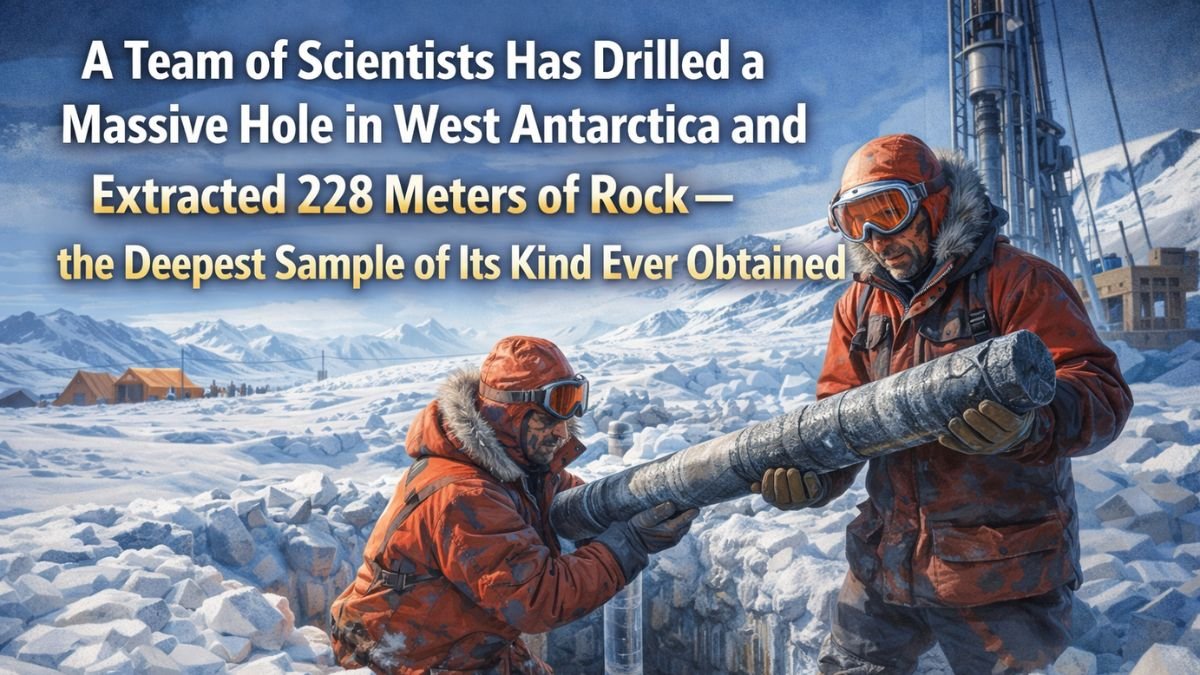
West Antarctica—one of the world’s coldest and most mysterious continents—has once again become a focal point of interest for scientists. Recently, a team of scientists drilled a massive hole here and retrieved a rock sample from a depth of 228 meters. This is considered to be the deepest and most unique sample ever obtained, raising hopes of uncovering numerous mysteries linked to Earth’s past.
Why is Reaching Such Depths Significant?
Extracting a rock sample from a depth of 228 meters is no ordinary feat. Antarctica’s thick ice sheet, extremely low temperatures, and harsh weather conditions make this task incredibly challenging.
This achievement holds special significance for scientists because it could provide them with geological and climatic clues dating back millions of years. This sample will aid in understanding a period in Earth’s history when the environment here was vastly different from what it is today.
The Objective Behind This Discovery
The primary objective of this mission is to determine Antarctica’s climatic history and the changes it has undergone over time. The minerals, fossils, and other elements hidden within the rocks can reveal what the temperatures were like here in the past, how thick the ice was, and how high the sea levels stood.
This information is crucial for understanding contemporary climate change, as past patterns allow us to anticipate future shifts.
The Drilling Process: A Fusion of Science and Technology
Drilling to such depths is an extremely complex process. Scientists utilized specialized equipment and techniques capable of cutting through ice and hard rock without causing any damage.
Maintaining temperature control during drilling and safely extracting the sample were the greatest challenges. Even a minor error could have compromised the entire sample; consequently, every step was executed with the utmost precision.
What Can This Rock Sample Reveal?
The sample retrieved from a depth of 228 meters is not merely a piece of rock; it is a historical document—a record of time itself. The layers contained within it narrate the story of changes that have unfolded over millions of years. By analyzing these layers, scientists can determine when ice formed and melted in Antarctica, as well as what the Earth’s temperature was like at those times. This information could prove invaluable in the study of global climate change.
Aiding in the Understanding of Climate Change
Today, the entire world is grappling with the problem of climate change. In this context, the samples retrieved from Antarctica help us understand how the Earth’s climate changes and what its consequences are.
If we can determine when and why ice melted in the past, we can better prepare for potential future changes. This is why this discovery is significant not only for scientists but for all of humanity.
Challenges and Risks
Scientists faced numerous difficulties during this mission. Extreme cold, strong winds, and limited resources made this task even more arduous.Furthermore, working in such a remote and isolated location poses a significant risk. Yet, despite all these challenges, the scientists succeeded in accomplishing what seemed like an impossible feat.
Future Prospects
This discovery could pave the way for even more extensive research endeavors in the future. Scientists can now plan to drill to greater depths and study new regions.This will not only unveil the mysteries of Antarctica but also yield new insights into the Earth’s history and its future.
Conclusion: A Discovery That Could Change History
Extracting a rock sample from a depth of 228 meters in West Antarctica represents a major scientific achievement. It not only helps us understand the past but also points toward a new direction for the future.
This discovery demonstrates that human curiosity, combined with the power of science, can overcome any challenge. In the times to come, the insights derived from this sample will provide the world with a fresh perspective on understanding climate change and the mysteries of the Earth.
FAQs
Q1. What did scientists discover in West Antarctica?
A. Scientists drilled a massive hole and extracted a 228-meter rock core, the deepest of its kind ever collected.
Q2. Why is this rock sample important?
A. It helps researchers study Earth’s past climate, ice sheet history, and geological changes over millions of years.
Q3. How was the rock sample collected?
A. Special drilling equipment was used in extreme Antarctic conditions to carefully extract the deep rock core.
Author

ranotiwari22@gmail.com
Related Posts

Hidden Pain of Venezuelan Migrants: The Psychological Crisis You Didn’t Know
- 0
- 997 words
Hidden Pain of Venezuelan Migrants: The continuous exodus of millions of people from Venezuela is not merely a story of physical displacement;...

Psychology tells us that adults who DON’T have close friends aren’t necessarily introverted or cold; many simply learned long ago that letting others get too close was the quickest way to get hurt
- 0
- 1,228 word
Psychology tells us that adults who DON’T have close friends aren’t necessarily introverted or cold: In today’s world, it is common for...

Psychology Explains Why 1960s and 1970s Kids Became Emotionally Strong Through Independence
- 0
- 1,266 word
The childhood experience of those who grew up in the 1960s and 1970s often looks dramatically different from what children experience today....

Psychology suggests that the kindest people don’t always end up surrounded by close friends; they have often learned to be helpful, understanding, and available in ways that make others feel cared for, but not necessarily understood by them
- 0
- 972 words
Kindness is often seen as a bridge that connects people, a quality that naturally attracts warmth, appreciation, and companionship. We tend to...

Exploring Behavioral Psychology: The Science Behind Human Actions
- 0
- 885 words
Behavioral Psychology is the science that seeks to understand the underlying causes behind human behavior. It is not limited merely to thoughts...

Powerful Behavioral Psychology Insights for Everyday Life
- 0
- 1,409 word
Human behavior often feels unpredictable, yet much of what we do follows patterns shaped by our thoughts, environment, and past experiences. Behavioral...
- applied behavioral psychology
- behavior change strategies
- behavior improvement tips
- behavioral psychology insights
- behavioral science concepts
- cognitive behavior patterns
- decision making psychology
- everyday psychology tips
- habit formation psychology
- human behavior psychology
- human thinking patterns
- mental behavior analysis
- psychological behavior insights
- psychology of actions
- psychology of habits