
- 0
- 1,480 word
There is a particular kind of silence that settles into your life as you grow older. It is not loud or dramatic. It does not arrive with a warning. Instead, it unfolds slowly, almost invisibly, until one day you notice it—and once you do, you cannot unsee it.
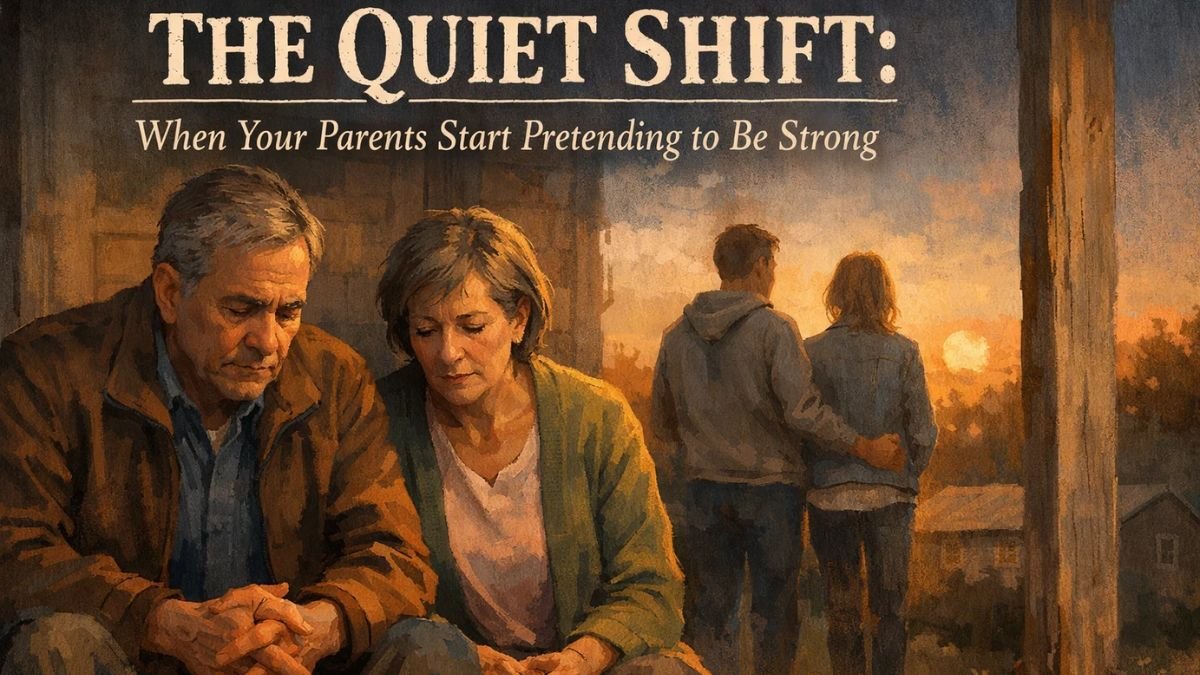
The hardest part of watching your parents age is often assumed to be physical decline. We imagine frailty, slower steps, and visible changes that remind us time is moving forward. But what truly unsettles us runs deeper than that. It is the moment you realize your parents are no longer simply being strong—they are performing strength.
It feels familiar in a strange way. Because once, not too long ago, you did the same thing.
When the Roles Begin to Blur
As children, we saw our parents as unwavering figures. They were the ones who knew what to do, who had answers, who handled problems with a certainty we trusted without question. Even when they were unsure, they rarely showed it. Their strength felt real, almost permanent.
But growing up changes perspective. Slowly, you begin to see the cracks—not as flaws, but as humanity. And then comes the realization that your parents are navigating uncertainty just as you once did when stepping into adulthood.
The difference is subtle but profound. When you were younger, you performed adulthood because you were trying to become something. Your parents, now, perform competence because they are trying not to lose something—the role of being the strong one.
The Familiar Mask of “I’m Fine”
If you pay close attention, you will notice the small shifts. The hesitation before answering a question. The way they brush off concerns with a quick “I’m fine.” The quiet avoidance of topics that reveal vulnerability.
It mirrors the same mask you wore when you first tried to prove you were capable. You smiled when you were unsure, nodded when you didn’t fully understand, and pretended to have everything under control because that is what adulthood seemed to demand.
Now, your parents do the same. Not because they want to deceive you, but because they want to protect something—your perception of them, your sense of security, or perhaps even their own identity.
The Weight of Reversal
There is an emotional weight that comes with this realization. It is not just about seeing your parents age; it is about recognizing that the roles you once held are beginning to shift.
You may find yourself explaining things to them, reminding them of details, or worrying about decisions they make. These moments are not dramatic on their own, but together they signal a quiet reversal.
And with that reversal comes discomfort.
Because deep down, you are not just adjusting to their aging—you are adjusting to the loss of who they used to be in your life. The ones who carried certainty now carry doubt. The ones who reassured you now seek reassurance, even if they never say it out loud.
Why They Keep Performing Strength
It is easy to wonder why your parents do not simply admit vulnerability. Why they do not openly say, “I don’t know,” or “I need help.”
The answer lies in identity.
For years—perhaps decades—their role has been to provide stability. Their sense of self is deeply tied to being dependable, capable, and strong. Letting go of that identity is not simple. It feels like losing a part of themselves.
So instead, they adapt. They perform competence in the same way you once performed adulthood—not because it is entirely real, but because it helps them hold onto who they believe they need to be.
The Emotional Conflict Within You
Recognizing this shift often brings a mix of emotions that are difficult to untangle. There is empathy, because you understand what it feels like to pretend you have everything together. There is sadness, because you see the effort behind their composure. And there is fear, because it signals change you cannot stop.
At times, you may feel frustrated. You might wish they would just be honest about their struggles. But beneath that frustration is a deeper truth—you are not just reacting to them, you are reacting to what their change means for you.
It means growing up in a way that feels permanent.
Learning to See Them Differently
One of the hardest adjustments is learning to see your parents as individuals rather than roles. For most of your life, they were defined by what they did for you—provider, protector, guide.
Now, you begin to see them as people who are navigating their own fears, uncertainties, and limitations. This shift in perspective is not easy, but it is necessary.
Because understanding them as individuals allows you to meet them where they are, rather than where you wish they still were.
Redefining Strength
Perhaps the most important realization in this journey is that strength itself is changing. For years, strength meant having answers, staying composed, and never showing weakness.
But as you watch your parents age, you begin to see that true strength is something else entirely.
It is the ability to keep going even when things feel uncertain. It is the quiet resilience of showing up despite fear. And sometimes, it is the courage to admit vulnerability—even if that courage comes slowly.
How to Respond With Care
When you notice your parents performing competence, your instinct may be to correct them, guide them, or take control. While these actions often come from a place of love, they can sometimes unintentionally reinforce their fear of losing independence.
Instead, what matters most is how you show up.
Patience becomes more important than correction. Listening becomes more valuable than advising. And respect becomes the foundation of every interaction.
Because even as roles shift, dignity should not.
Holding Space for What Is Changing
There is no perfect way to navigate this transition. It is not something you can prepare for completely, nor is it something you can control.
What you can do is hold space—for their experience and for your own.
Allow yourself to feel the discomfort without rushing to fix it. Allow them to maintain their sense of self without forcing them into vulnerability they are not ready to express. And most importantly, allow the relationship to evolve.
Because it will.
The Quiet Beauty in the Shift
While this transition is often painful, it also carries a quiet kind of beauty. It creates an opportunity to connect with your parents in a new way—not as authority figures, but as human beings.
There is depth in conversations that were once surface-level. There is understanding where there was once assumption. And there is a chance to build a relationship based not just on roles, but on mutual awareness.
In many ways, you are not losing your parents—you are meeting them again, for the first time, as they truly are.
Accepting What Cannot Be Reversed
The truth is, there is no going back to how things were. The version of your parents you grew up with exists in memory, not in the present.
And while that realization can feel heavy, it also brings clarity.
It reminds you to appreciate what still exists. To value the moments you have. And to recognize that change, while difficult, is also a natural part of life.
Because just as you once stepped into adulthood with uncertainty, your parents are now stepping into a phase of life that requires its own kind of courage.
FAQs
Q1. Why do parents hide their struggles as they age?
They often want to maintain their identity as strong and independent, avoiding burdening their children.
Q2. How should I react when I notice this change?
Respond with patience, empathy, and respect rather than trying to take control immediately.
Q3. Is role reversal in families normal?
Yes, it is a natural part of life as both generations grow and adapt to new realities.
Author

khushiiiyadavvv21@gmail.com
Related Posts

Hidden Pain of Venezuelan Migrants: The Psychological Crisis You Didn’t Know
- 0
- 997 words
Hidden Pain of Venezuelan Migrants: The continuous exodus of millions of people from Venezuela is not merely a story of physical displacement;...
Psychology tells us that adults who DON’T have close friends aren’t necessarily introverted or cold; many simply learned long ago that letting others get too close was the quickest way to get hurt
- 0
- 1,228 word
Psychology tells us that adults who DON’T have close friends aren’t necessarily introverted or cold: In today’s world, it is common for...

Psychology Explains Why 1960s and 1970s Kids Became Emotionally Strong Through Independence
- 0
- 1,266 word
The childhood experience of those who grew up in the 1960s and 1970s often looks dramatically different from what children experience today....

Psychology suggests that the kindest people don’t always end up surrounded by close friends; they have often learned to be helpful, understanding, and available in ways that make others feel cared for, but not necessarily understood by them
- 0
- 972 words
Kindness is often seen as a bridge that connects people, a quality that naturally attracts warmth, appreciation, and companionship. We tend to...

Exploring Behavioral Psychology: The Science Behind Human Actions
- 0
- 885 words
Behavioral Psychology is the science that seeks to understand the underlying causes behind human behavior. It is not limited merely to thoughts...

Powerful Behavioral Psychology Insights for Everyday Life
- 0
- 1,409 word
Human behavior often feels unpredictable, yet much of what we do follows patterns shaped by our thoughts, environment, and past experiences. Behavioral...
- applied behavioral psychology
- behavior change strategies
- behavior improvement tips
- behavioral psychology insights
- behavioral science concepts
- cognitive behavior patterns
- decision making psychology
- everyday psychology tips
- habit formation psychology
- human behavior psychology
- human thinking patterns
- mental behavior analysis
- psychological behavior insights
- psychology of actions
- psychology of habits